
Ransomware Data Recovery Hinges on More Than the Ransom Decision

The real success of ransomware data recovery depends on backup integrity, network isolation, and restoration testing—not just the ransom decision. Focusing only on whether to pay overlooks the steps that actually determine if your business can recover.
When ransomware locks every file on a company's network, the cost isn't just the ransom demand - it's the days of halted operations, the customers who can't be served, and the data that may never come back no matter what gets paid. That's the real stake in ransomware data recovery.
Most people treat it as a single yes-or-no decision: pay the attacker or don't. But that framing misses the point, because the ransom is rarely what decides whether a business actually gets its data back. What decides it is whether the recovery plan behind the scenes holds up once it's actually needed.
Even the odds look better than the fear suggests: one industry report found that 94% of organizations whose data was encrypted were able to recover it, but the path to that result is rarely straightforward. Getting there depends on groundwork laid long before an attacker ever gets in. The rest of this article walks through the four conditions that actually decide whether a business can recover from a ransomware attack.

Why the ransom payment is only one piece of the recovery process
Deciding whether to pay the ransom feels like the central decision after an attack, and it is a critical one, but it's only one part of a much larger recovery process.
Paying might seem like the fast way out, yet it guarantees nothing: attackers can hand over a faulty decryption tool, or simply vanish once the payment clears. Even when the tool works, restoring encrypted files through it can be slow and unreliable, dragging out the very downtime the payment was supposed to end.
That gap is exactly why fixating on the ransom decision leaves a business exposed. The real outcome traces back to what was in place before the attack and how the response unfolds after it. Payment is a single link in a longer chain, and the rest of that chain carries just as much weight - sometimes more.
The hidden factors that decide ransomware recovery success
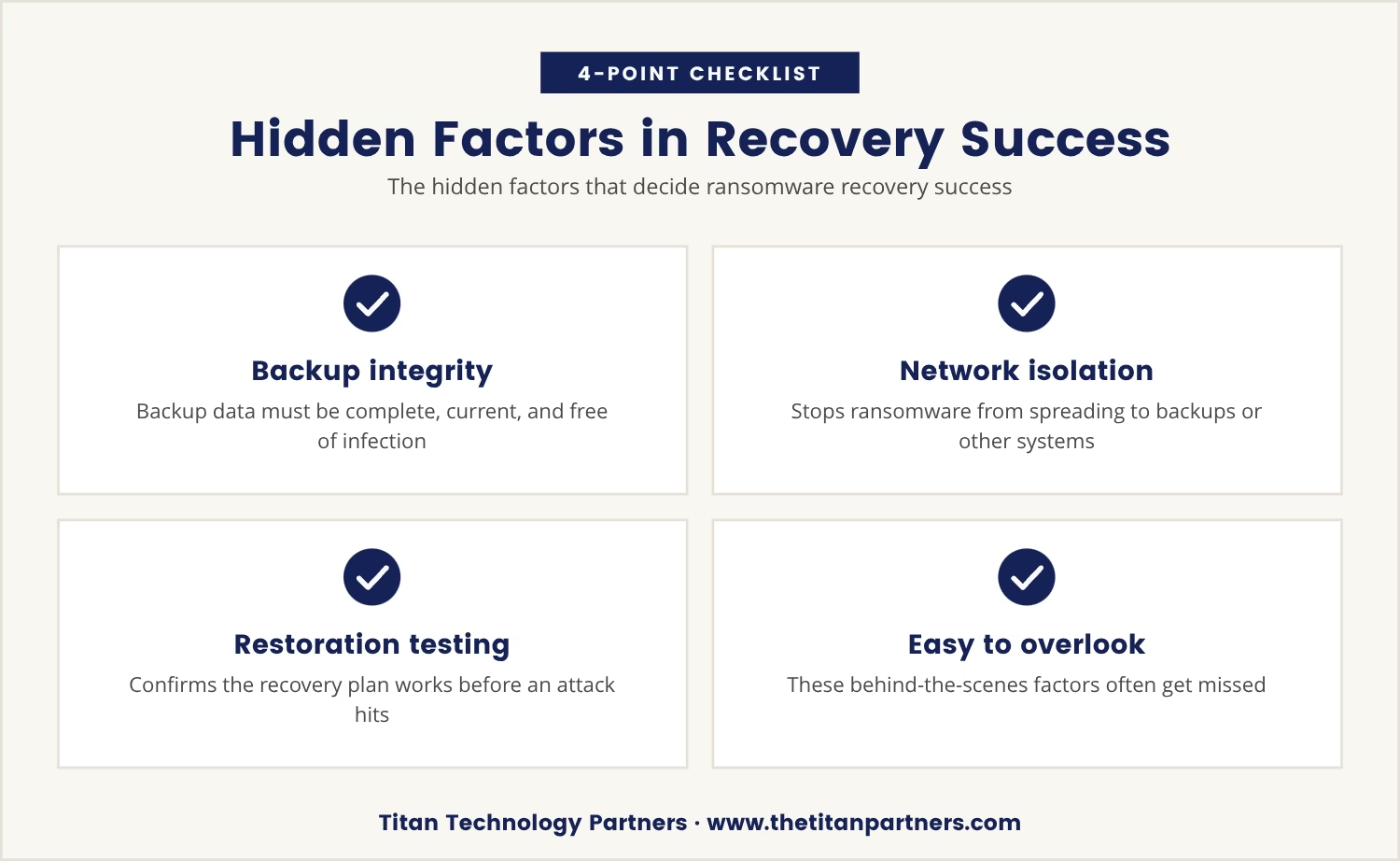
Behind most ransomware incidents affecting businesses in New York, it's the unglamorous technical details that end up shaping the outcome, not the headline decision. Three conditions in particular - backup integrity, network isolation, and restoration testing - carry more weight than most realize.
Backup integrity means the backup data is complete, current, and untouched by the infection; when backups are compromised or stale, everything downstream gets harder. Network isolation follows naturally from that concern, since stopping the ransomware from reaching backups or other systems is what keeps a bad situation from becoming a worse one. Restoration testing closes the loop by confirming the recovery plan actually works under pressure, rather than revealing its flaws only after the attack has already happened.
Because these factors sit behind the scenes, they're easy to overlook - yet they're the real difference between a smooth recovery and a prolonged crisis. A business fixated only on the ransom decision risks missing them entirely.
Four conditions that determine ransomware data recovery outcomes
Given everything above, the success of ransomware data recovery comes down to four specific conditions, and only one of them involves the ransom itself. The other three are technical and operational steps that have to be in place before an attack ever happens.
Backup integrity
Backups need to be recent, complete, and protected from ransomware; if they're missing or infected, recovery becomes nearly impossible.
Network isolation
Once ransomware is detected, isolating affected systems and backups stops the infection from spreading further, and acting quickly here limits the damage considerably.
Restoration testing
Testing the recovery plan on a regular basis confirms that data can actually be restored when needed. Skip the testing, and the plan may fail at the exact moment it matters most.
Ransom decision
Whether to pay still matters, but it only helps once the other three conditions are already met. Even a successful payment can't fix a recovery if the backups are bad or the systems are still compromised.
Why backup integrity is the real foundation for recovery
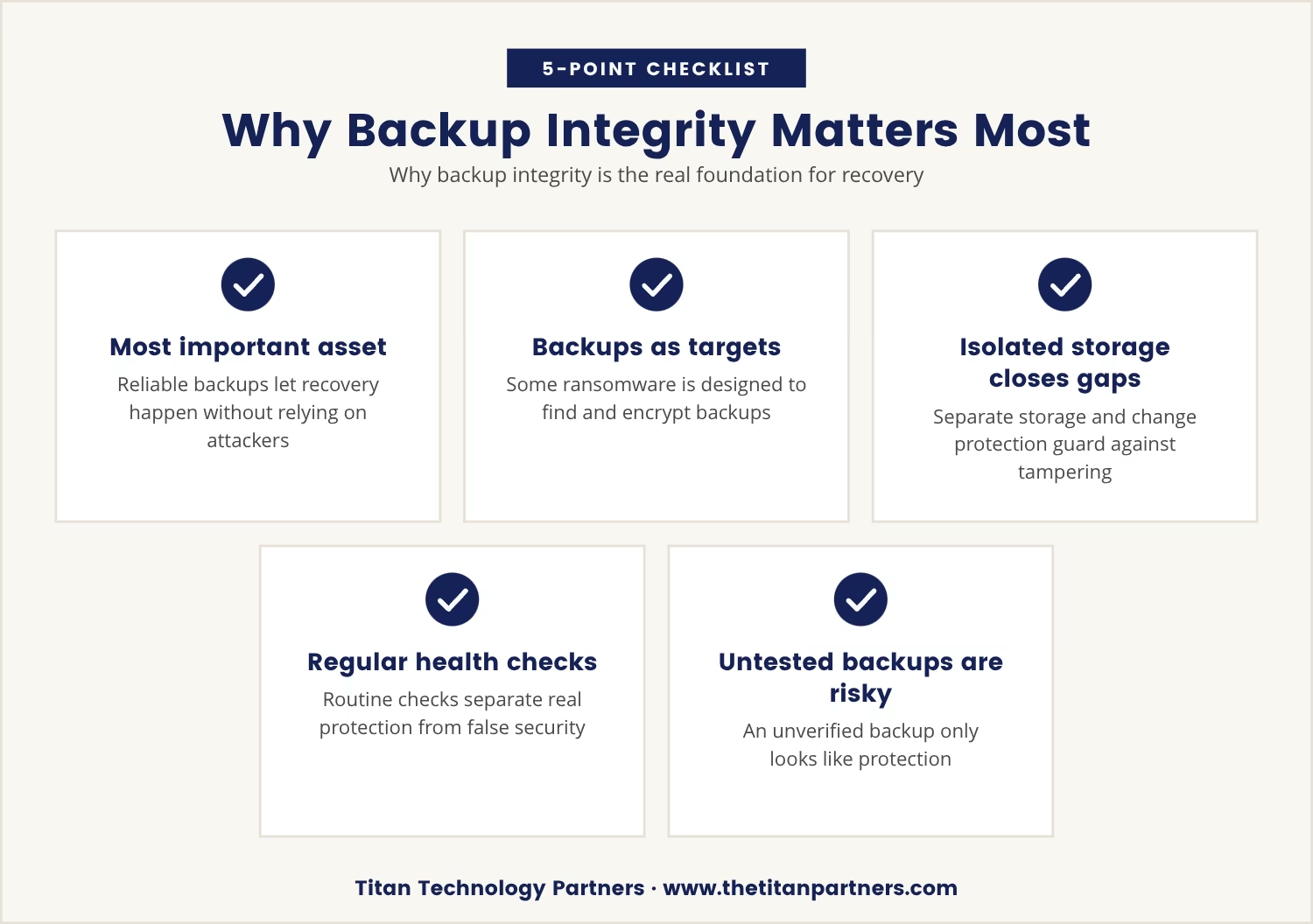
Of the four conditions, a reliable backup is the single most important asset during a ransomware incident, since current, safely stored backup data offers a way to restore systems without depending on attackers at all.
That said, backups are frequently the target rather than the safety net: some ransomware variants are built specifically to seek out and encrypt backup files, rendering them useless at the exact moment they're needed. Storing backups in locations isolated from the main network, and choosing backup solutions that guard against unauthorized changes, closes that gap.
For businesses in New York and beyond, checking backup health on a regular basis isn't optional - it's the difference between a safety net and a false sense of security. A backup that hasn't been tested or updated is a risk masquerading as protection. Only verified, protected backups make it possible to recover data with real confidence after an attack.
Restoration testing: The overlooked step in recovery strategies
A recovery plan that's never been tested is still just a theory. Restoration testing means simulating a ransomware attack and confirming that data and systems can actually be restored quickly when it counts.
Skip that step, and the gaps surface at the worst possible time - incomplete backup files, restoration methods too slow to matter, a team unsure of its own next move. Testing regularly exposes those gaps while there's still time to fix them.
Ask yourself: when was the last time the recovery plan was tested start to finish? If the answer isn't clear, the business may be more exposed than it seems.
Practical steps for building a successful ransomware recovery plan
A strong recovery plan involves more than deciding whether to pay. These practical steps build real readiness:
- Regular backup audits: Check backups often to confirm they're complete and protected from ransomware.
- Isolate backup systems: Store backups somewhere ransomware can't reach, such as offline storage or cloud storage with restricted access.
- Test restoration procedures: Practice restoring data from backups so the process is proven and the team knows what to do.
- Update your recovery plan: Revisit the plan as systems and threats evolve, so it keeps pace with both.
- Train your team: Make sure everyone, from IT staff to leadership, knows their role when a ransomware incident hits.
Bringing it all together: What really determines recovery success
By the time a ransom demand appears, the real outcome of the attack has largely already been decided. Backup integrity, network isolation, and restoration testing are the conditions that determine whether data and systems can actually be recovered, with the ransom decision standing as only one part of that story.
A business that focuses solely on whether to pay risks missing the steps that actually determine the outcome. Strong backups, an isolated network, and a tested recovery plan together give a business its best shot at restoring operations and moving forward.

How we help businesses prepare for ransomware recovery
Many organizations with 15 to 50 users find themselves unsure if their recovery plan would hold up under a real ransomware attack. At Titan Technology Partners, we understand how critical it is to have more than just a ransom decision in place.
If you want to see how we approach ransomware recovery planning, or talk through your current setup, we invite you to start a conversation with our team.
Ready to standardize your recovery process?
Qualifying businesses can secure and standardize their IT in 90 days with Titan Technology Partners, or pay no onboarding fee.
Frequently asked questions
What should I do first if I discover a ransomware infection?
Isolate affected systems from the network immediately to stop the ransomware from spreading, disconnecting infected devices and alerting the IT team without delay. Acting quickly at this stage limits the damage and helps protect backup data from also becoming compromised.
How can I make sure my backup data is safe from ransomware?
Keep backups in locations not directly connected to the main network, such as offline drives or secure cloud storage, and use backup solutions that guard against unauthorized changes. Testing those backups regularly confirms they stay complete and usable when needed.
Do I need to pay the ransom to recover encrypted files?
Paying is not always necessary or even effective. Reliable, isolated backups paired with a tested recovery plan often make it possible to restore data without paying anything at all, though missing or compromised backups narrow those options considerably.
What are the best practices for ransomware recovery strategies?
Strong practices include keeping regular, protected backups, isolating backup systems, testing the recovery plan, and training the team. Together these steps make it possible to recover data and systems quickly after an attack.
How often should I test my recovery plan?
Test the recovery plan at least once or twice a year, and again whenever significant changes are made to the IT systems. Regular testing catches gaps while there's still time to fix them, rather than during an actual ransomware incident.