Managed Firewall Services: Does In-House Coverage Really Hold Up?

Relying on a single in-house firewall administrator often leaves small and midsize networks exposed during absences or off-hours. Managed providers are structured to deliver the continuous coverage and rapid response that internal hires can’t match.
A network protected by only one firewall administrator carries a built-in cost: the moment that person is unavailable, unpatched vulnerabilities sit open and suspicious activity goes unreviewed, and either one can turn into a breach that takes days and real money to clean up.
That risk doesn't announce itself. It sits quietly in the gap between when a threat appears and when someone capable of acting on it is actually watching.
A single administrator, no matter how skilled, is still one person with a schedule, a skill set, and a finite set of working hours. Sick days, vacations, and resignations all shrink that schedule further, and each shrinkage is a window where the network's defenses are effectively unattended.
Managed firewall services close that window by replacing one person's attention with a team's, and with monitoring that doesn't take days off. For small and midsize businesses, where there's rarely a backup administrator waiting in the wings, that difference isn't a convenience — it's the thing standing between a caught threat and a costly one.

Why relying on one person for firewall management creates risk
Depending on a single administrator means betting network security on that person's constant presence, and presence is never actually constant. A sick day, a vacation, or a sudden resignation can drop coverage to zero without warning.
Even a fully engaged administrator still sleeps, takes weekends, and steps away from a screen eventually, and attackers plan around exactly that rhythm — probing on weekends, holidays, and late at night, when a slow response is most likely. The result is that an organization's riskiest hours often line up precisely with its least-staffed ones.
That same unavailability delays more than incident response. Patches and updates queue up while the administrator is out, and every day a known vulnerability sits unpatched is a day an attacker already scanning for it has to find it first.
Underneath all of this sits a structural weak point: if the firewall's configuration lives mainly in one person's head, their departure doesn't just remove a worker, it removes institutional knowledge. Whoever inherits the system has to reverse-engineer it under pressure, and that learning curve is exactly where mistakes and missed alerts creep in.
What managed firewall services actually provide
Where a single hire offers one set of eyes, managed firewall services bring a team, automated tooling, and processes that have already been tested against a wide range of attack patterns. The shift isn't just more staff — it's a different operating model.
Real-time monitoring sits at the center of that model, flagging threats the instant they surface rather than whenever someone next checks in. That means coverage at 2 a.m. on a Sunday is identical to coverage at 2 p.m. on a Tuesday.
Configuration, updates, and routine audits are handled as standard practice rather than squeezed in around other duties, which keeps misconfiguration risk down and defenses current without relying on one person's memory of what needs attention.
And when something does get through, response doesn't wait for someone to notice. Managed firewall service providers have teams trained to act immediately, which limits how far a breach spreads before operations return to normal.
Managed firewall services in New York: What local businesses should know
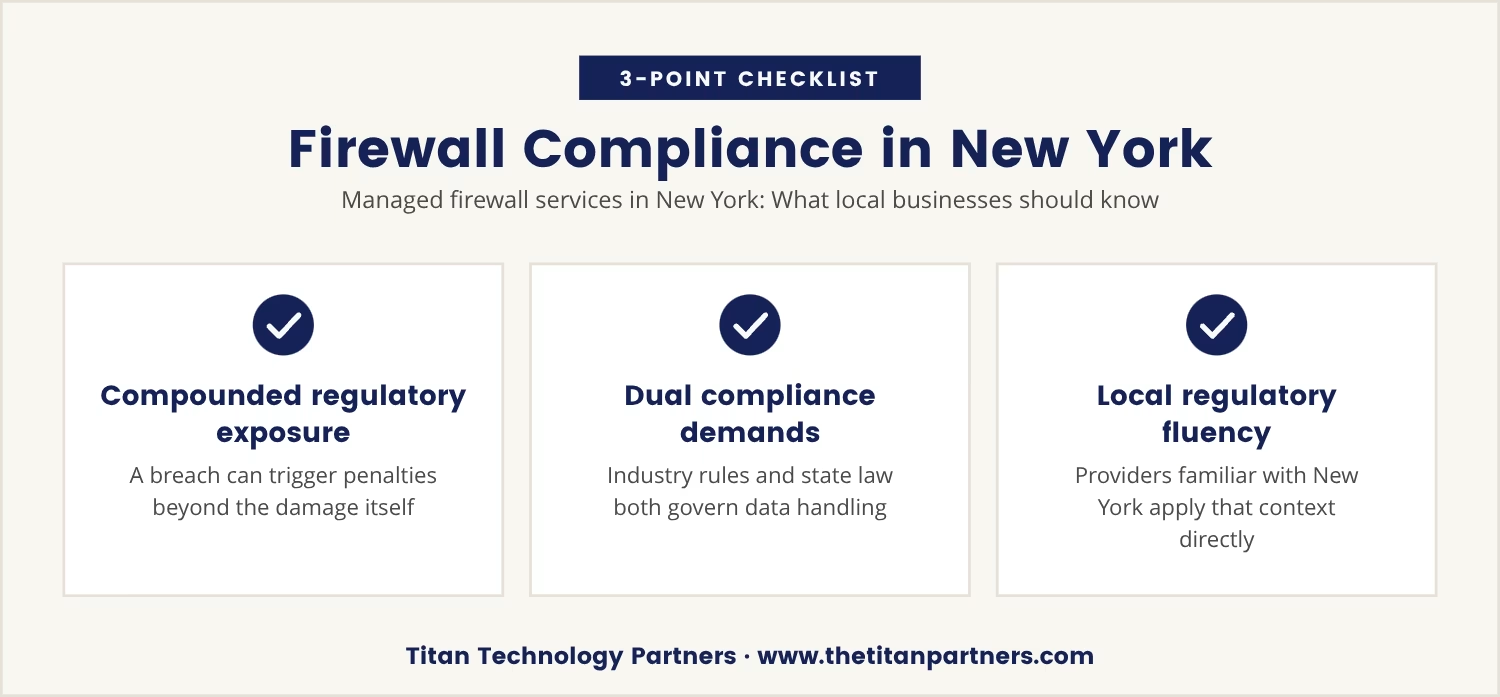
For businesses operating in New York, the margin for error narrows further because regulatory exposure compounds the usual security risk. A single breach here doesn't just cost cleanup time — it can trigger compliance penalties layered on top of the damage itself.
Industry-specific rules and state law both shape how sensitive data has to be handled, and meeting both at once takes more than general best practices. Managed firewall services built around these requirements help keep network security aligned with what regulators actually expect, which cuts down the risk of fines or reputational fallout stacking on top of an incident.
That regulatory fluency tends to come with local familiarity, too: providers who already understand New York's threat landscape and compliance expectations can apply that context directly, rather than treating every business as a generic case.
How managed firewall services close the coverage gap
Given that single-administrator setups leave predictable openings, managed firewall services are built specifically to close them. The mechanisms behind that are concrete:
24/7 monitoring and response
Coverage runs continuously, so a threat appearing at midnight gets the same attention as one appearing at noon — not whatever attention is available once business hours resume.
Team-based expertise
A group of specialists, rather than one administrator, means a broader range of attack types is already familiar territory to someone on the team.
Automated alert systems
Suspicious activity triggers instant alerts, which shrinks the time between an anomaly appearing and someone actually acting on it.
Regular updates and patching
Patching happens on an ongoing schedule rather than whenever time allows, which keeps known vulnerabilities from sitting open and exploitable.
Documentation and continuity
Detailed records of firewall management mean a staffing change doesn't start the system over from scratch.
Compliance support
Audits and inspections become less of a scramble when a provider is already tracking what regulations require.
The hidden costs of in-house firewall management
Keeping firewall management in-house looks cheaper on paper, largely because the real costs don't show up until coverage actually fails. That gap between apparent and real cost is where the risk hides.
Covering an absent administrator often means overtime pay or temporary staffing, and bringing a new hire up to speed on a complex network takes real time — time during which coverage is thinner than it looks.
If a breach happens to land in that unmonitored window, the financial and reputational fallout can dwarf whatever was saved by not outsourcing in the first place. A coverage gap that lasts only a few hours can still produce consequences that last for months.
Key advantages of managed firewall monitoring
- Constant vigilance: Every hour is covered, so threats get caught before they escalate rather than after.
- Expert support: A full team stays current on evolving threats and best practices, not just one person's training.
- Fast response: Providers act quickly enough to stop attacks before damage compounds.
- Reduced downtime: Problems get resolved while still small, keeping daily operations steady.
- Simplified compliance: Regulatory requirements get handled as routine, not as a scramble before an audit.
Why the managed approach is safer for small and midsize networks
Those same hidden costs hit small and midsize businesses hardest, since resources for cybersecurity are usually tighter to begin with. Fewer resources mean less room to absorb a coverage gap or a delayed response, which makes the gap itself more dangerous.
A managed firewall service offsets that by supplying continuous protection and depth of expertise no single hire could match alone. The real shift isn't technological — it's structural: security stops depending on any one person's calendar.
For any business still relying on a lone administrator, the honest question is simple: who's covering the network when that person isn't available? For many, the answer is no one, and that absence is exactly when attackers are most likely to test the defenses.
Shifting firewall management to a provider removes that exposure entirely. Vacations, sick days, and after-hours emergencies stop being security risks, because network protection no longer hinges on a single person being reachable.

How Titan Technology Partners helps you avoid coverage gaps
Many businesses with 15 to 50 users find themselves depending on a single person for firewall management, which can leave them exposed when that person is unavailable. At Titan Technology Partners, we understand how easily these gaps can occur and how costly they can become.
If you want to see how we approach continuous network security, let’s talk about your current setup and what it would take to keep your business protected at all times.
Ready to close your firewall coverage gaps?
Qualifying businesses can secure and standardize their IT in 90 days with Titan Technology Partners or pay no onboarding fee.
Frequently asked questions
How does managed firewall monitoring differ from in-house management?
Managed firewall monitoring means a provider watches the network continuously, using automated tools and a team of experts to respond to threats immediately. In-house management typically relies on one person or a small team, which creates gaps during off-hours or absences.
What happens if my firewall administrator leaves suddenly?
A sudden departure usually means delays while a new hire learns the system from scratch. Managed firewall service providers avoid that by keeping detailed documentation and having teams ready to step in without any loss of coverage or institutional knowledge.
Can managed firewall services help with compliance requirements?
Yes. Managed firewall services typically include compliance support through recordkeeping, adherence to industry standards, and audit assistance, which makes meeting legal and regulatory requirements considerably less labor-intensive.
Are managed firewall services only for large companies?
No. Small and midsize businesses often benefit the most, since they typically lack the resources for full-time, in-house firewall management. Providers scale their services to match a business's size, putting advanced protection within reach regardless of company scale.
How quickly can a managed firewall service respond to a security alert?
Most providers rely on real-time monitoring and automated alerts, which allows them to respond within minutes even outside normal business hours. That speed is what keeps a potential breach's impact contained.