
IT Cost Reduction Strategies: Where the Hidden Spending Really Goes

Standard budget reviews often miss five key areas where IT spending hides in plain sight. Finding and addressing these hidden costs lets you redirect money without affecting your core systems or headcount.
It's widely assumed that a thorough IT budget review catches every wasteful expense. In practice, the costs that do the most damage are the ones no standard review ever surfaces.
When these costs slip by unnoticed, projects stall, upgrades get delayed, and the pressure to cut visible expenses grows heavier than it needs to be.
That pressure is misplaced, because IT cost reduction strategies are supposed to manage spending overall, yet most reviews miss the less obvious areas where money leaks out. Left unchecked, these hidden pockets of spending add up fast, making it harder to meet business objectives without resorting to tough choices.
Tough choices like cutting staff or eliminating core systems are rarely the real answer, though. The more useful work is finding and redirecting the money that hides in plain sight. Once you know where to look, you can make smarter decisions that protect your team and your essential operations.

The illusion of a complete IT budget review
Most businesses believe that a thorough budget review will catch all unnecessary IT spending, but that confidence is exactly what lets the smaller leaks go unnoticed.
A standard IT budget review usually focuses on big-ticket items—hardware, software, and staffing. These are easy to spot and account for, but they're rarely the full story, since many smaller or less visible expenses get bundled into general categories or overlooked entirely.
That blending happens because IT spending is spread across departments, projects, and even individual employees. When costs are scattered this way, patterns and duplications are easy to miss. Overlapping software licenses or underused cloud services, for instance, rarely stand out in a high-level review.
As a result, businesses in New York and beyond often accept these hidden costs as unavoidable. Yet a more detailed approach can uncover areas where spending gets trimmed without touching core systems or reducing staff.
Five places IT spending hides in plain sight
Some IT expenses are easy to overlook, yet they can weigh heavily on the bottom line. Here are five areas where hidden costs often escape notice during standard reviews:
1. Shadow IT and unauthorized tools
Employees sometimes bring in their own apps or services to get work done faster. These tools, known as shadow IT, can lead to duplicate spending and security risks, and because they sit outside official procurement processes, their costs often go unnoticed.
2. Overlapping software licenses
It's common for different teams to buy similar software without coordinating, which results in multiple licenses for the same or similar tools and drives up overall expenditure. Regular audits can help identify and consolidate these licenses.
3. Underused cloud resources
Cloud services are easy to scale up, but just as easy to forget about. Unused virtual machines, storage, or services can keep running—and charging you—long after they're needed, though automated monitoring can help spot and shut down these resources.
4. Forgotten maintenance contracts
Maintenance agreements for hardware or software sometimes renew automatically, even when the equipment is no longer in use. Left unreviewed, these recurring costs can pile up, especially in environments with frequent upgrades or changes.
5. Departmental IT spending outside central oversight
Individual departments may purchase their own IT solutions, bypassing central IT or procurement altogether. These decentralized purchases can duplicate existing services or introduce compatibility issues, all while keeping costs hidden from the main budget.
Why these hidden costs matter for cost optimization
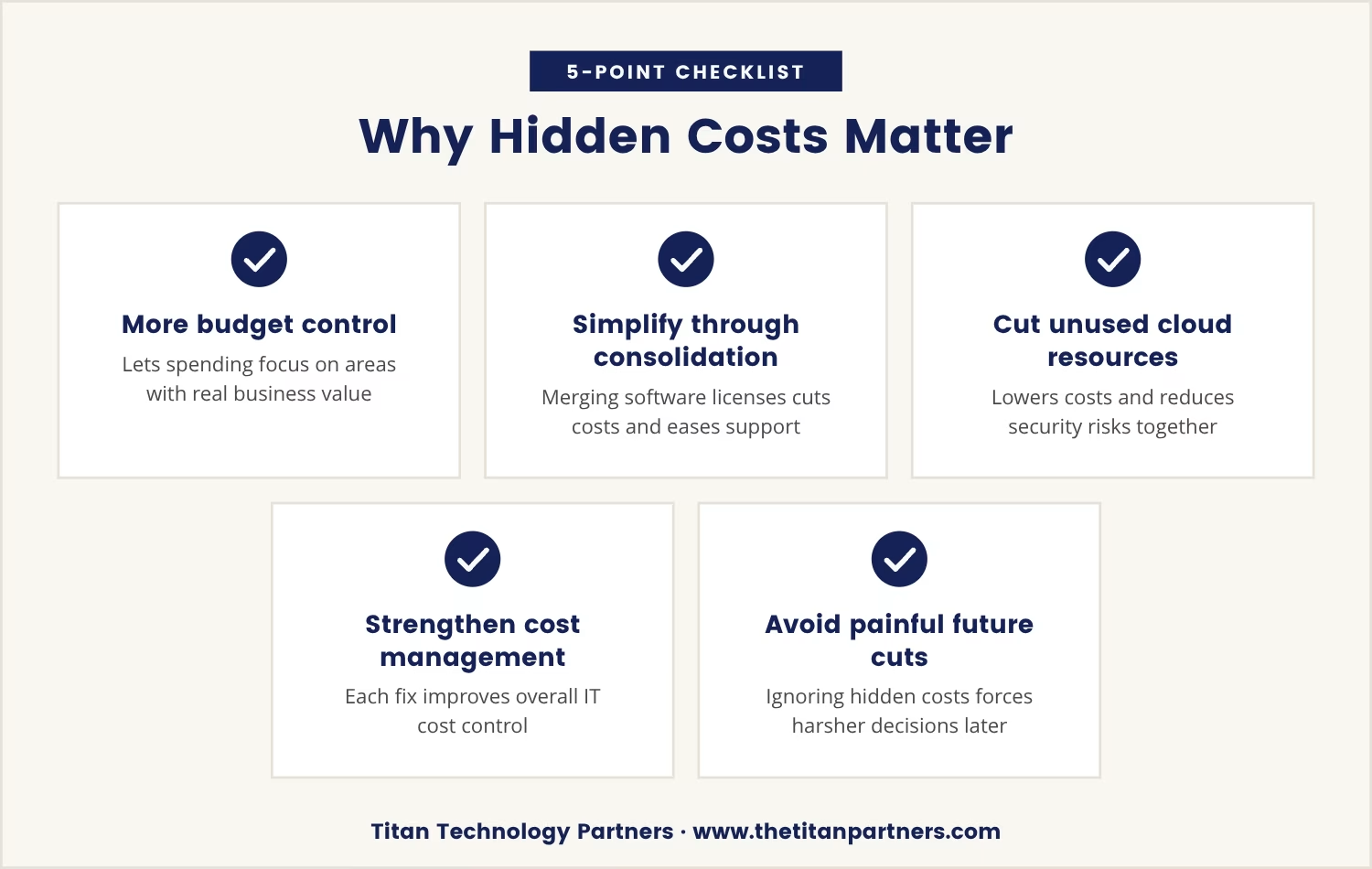
Uncovering these hidden areas is about more than just saving money—it's about improving efficiency and making IT investments work harder. Addressing these overlooked expenses hands you more control over your budget, so spending can be prioritized where it delivers real business value.
Consolidating software licenses, for example, not only reduces costs but also simplifies support and training. Shutting down unused cloud resources lowers operational costs and reduces security risks at the same time. Each action strengthens overall IT cost management.
Left unaddressed, though, these hidden costs tend to force more painful cuts later. Acting early avoids those tough decisions and keeps operations running smoothly.
IT cost reduction strategies that actually work
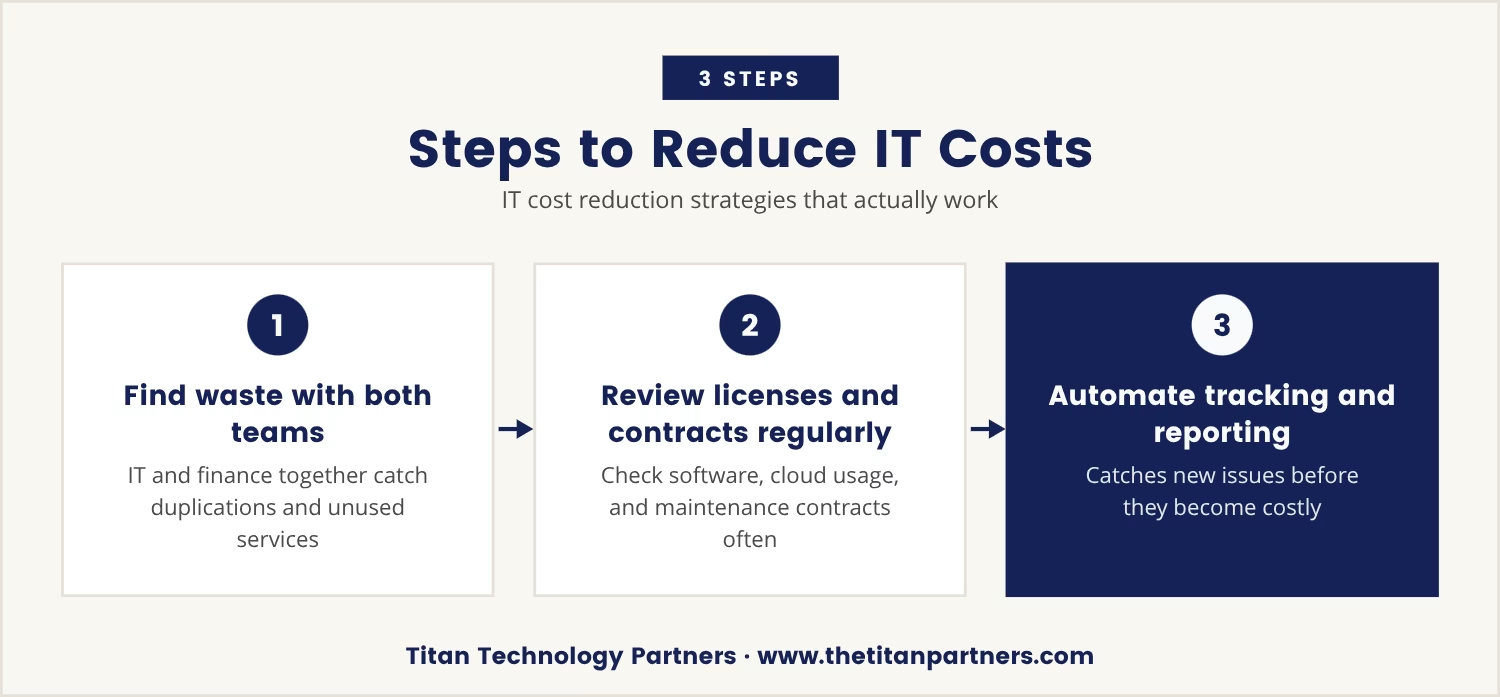
Many businesses try to cut costs by targeting visible expenses, but the most effective strategies focus on the hidden areas outlined above. Here's how to approach IT cost reduction strategies for lasting results:
Start with a detailed audit of all IT spending, not just the main budget lines. Look for patterns, duplications, and services that are no longer needed, and involve both IT and finance teams so nothing slips through the cracks.
From there, set up regular reviews of software licenses, cloud usage, and maintenance contracts. Automation, where possible, helps track and report on these areas, catching new issues before they turn into expensive problems.
Finally, encourage departments to coordinate their IT purchases through a central process. Doing so reduces duplication and keeps spending aligned with business objectives.
How to spot hidden IT spending in your own business
If you're wondering where to begin, focus on these practical steps to uncover hidden costs:
- Map all IT-related expenses: List every recurring and one-time IT cost, including those made by individual departments.
- Audit software and cloud usage: Compare what you're paying for against what's actually being used.
- Review maintenance and support contracts: Check for renewals on equipment or software no longer needed.
- Centralize procurement: Require all IT purchases to go through a single process for better visibility.
- Educate staff about shadow IT: Make sure employees understand the risks and costs of using unauthorized tools.
Taken together, these steps can reveal spending you didn't realize was there, opening the door to redirect funds toward more valuable initiatives.
The long-term impact of addressing hidden IT costs
Addressing hidden IT spending isn't a one-time fix—it's an ongoing process that supports sustainable cost reduction. Consistent monitoring and management of these areas builds a culture of accountability and efficiency over time.
That consistency eventually frees up resources for innovation, growth, or simply peace of mind. Instead of cycling through emergency cost-cutting, a business builds a stable, predictable IT budget.
If these hidden areas haven't been examined closely before, now is the time to start, since the benefits go beyond immediate savings and extend to a stronger, more resilient business.

Take control of hidden IT costs with Titan Technology Partners
Many businesses with 15 to 50 users find themselves surprised by IT expenses that don’t show up in standard reviews. At Titan Technology Partners, we understand how frustrating it can be to manage costs without sacrificing your team or essential systems.
If you want to see how we approach uncovering hidden IT spending, or if you’d like to talk about your own setup, we’re here to help.
Ready to standardize your IT and save on onboarding?
Qualifying businesses can secure and standardize their IT within 90 days, and if we don’t deliver, you pay no onboarding fee.
Frequently asked questions
How can I identify shadow IT in my organization?
Start by reviewing network logs and expense reports for unfamiliar software or services. Encourage employees to report any tools they use outside official channels, and reinforce this with regular communication and clear policies to reduce shadow IT over time.
What's the best way to consolidate software licenses?
Begin with a full inventory of all licenses across departments, then look for overlaps and negotiate with vendors for enterprise agreements or volume discounts. Consolidation not only saves money but also simplifies support and updates.
Are there tools to automate cloud cost management?
Yes, many cloud providers offer built-in tools for tracking usage and spending. Third-party solutions can also provide real-time insights and automated alerts for unused or underused resources, making it easier to manage operational costs.
How do I avoid paying for redundant maintenance contracts?
Set calendar reminders to review all maintenance agreements before renewal dates. Cross-check contracts with current hardware and software inventory to ensure payment only covers what's actually in use.
Why is centralizing IT procurement important for cost control?
Centralizing procurement increases visibility and reduces the risk of duplicate purchases. It also allows for better negotiated terms with suppliers and keeps spending aligned with overall business needs.