
IT Change Management: Does More Process Always Mean Less Risk?
Copying a full ITIL change management process into a small business can actually increase risk and overhead, not reduce downtime. More process doesn't always mean fewer failures—sometimes it just means more paperwork.
Every IT update moves through the same basic sequence: someone proposes a change, someone reviews it, someone approves it, and only then does it reach the live system. Add steps to that sequence, and each one takes time, whether or not it catches a real problem.
The sequence looks safer with more checkpoints built in, which is why so many business owners hear that ITIL change management is the gold standard for handling changes in IT systems.
Yet each checkpoint added to that sequence has a cost, and the cost doesn't always buy back the risk it claims to remove. Layers of approval and documentation pile onto the process without necessarily touching the odds of downtime, so the business ends up paying in time and money for paperwork while the original problem sits untouched.
Strip away the framework language, and IT change management simply means controlling how updates, fixes, and new features reach your technology. The point of doing that well is a business that runs without unexpected disruption or wasted effort, which is exactly where a mismatched process starts working against itself.

When more process means more problems
A formal change management process exists to catch mistakes before they happen, and that logic holds up right until the process outgrows the team running it. For a small business, structure built for catching rare, high-stakes errors can slow down the routine work that makes up most of the week.
Once every change needs to clear a long list of approvals, a simple update can take days or weeks to land. That delay lands hardest on a team trying to fix something quickly, and frustration follows close behind.
The same extra steps that slow routine work also get in the way when something urgent breaks. A business that depends on fast decisions loses that speed to a heavy process, and the risk doesn't disappear — it just relocates to wherever the bottleneck sits.
Matters get worse when the people reviewing a change aren't the ones who understand its details. A new or ill-fitting process then produces confusion on top of delay, which is the opposite of what it was built to prevent.
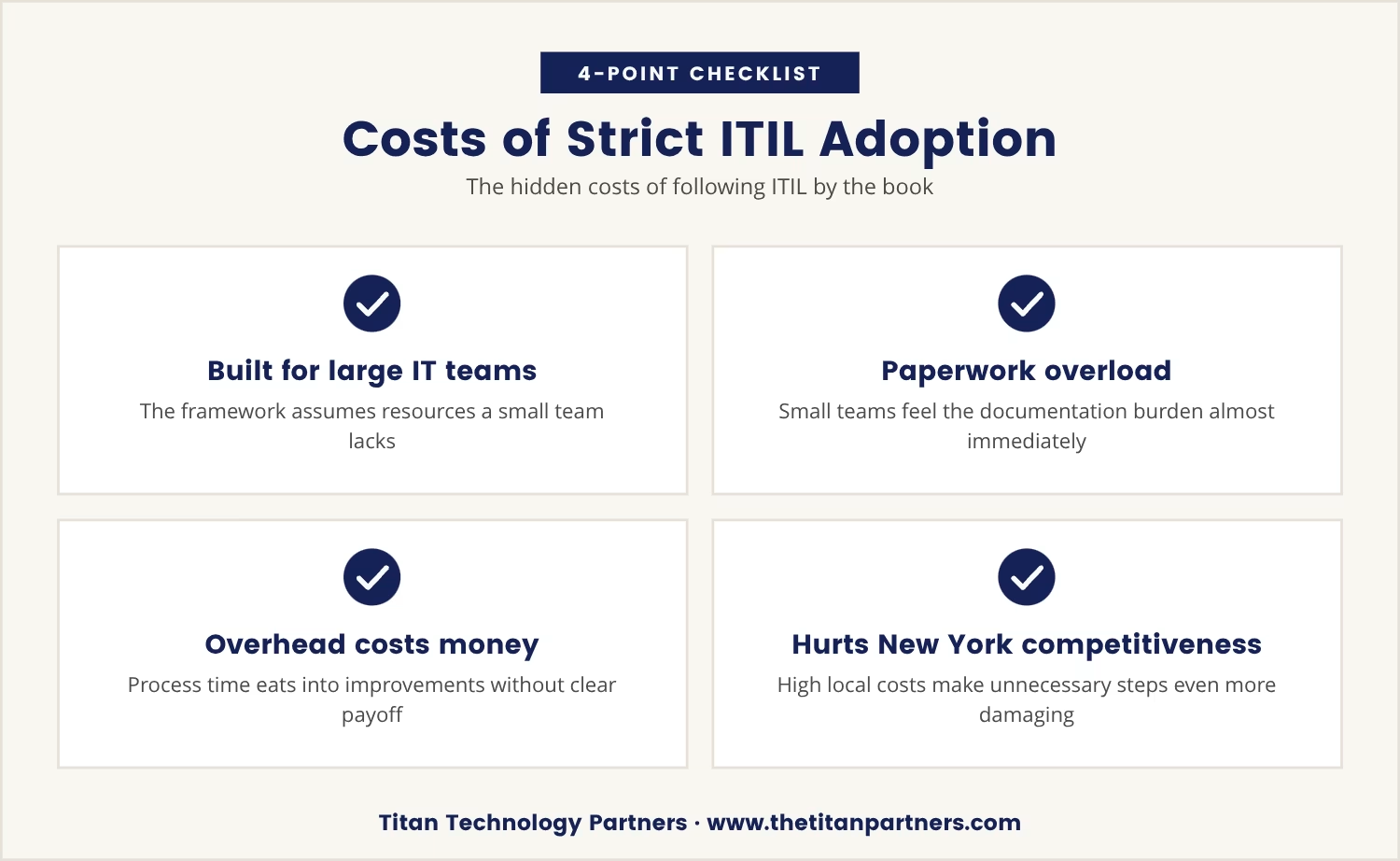
The hidden costs of following ITIL by the book
ITIL is the best-known framework for managing IT services, built around the promise of consistency and control. That promise was shaped for large organizations with correspondingly large IT teams, which matters once a much smaller team tries to adopt it wholesale.
Followed step by step exactly as written, ITIL buries a team in documentation and meetings, and a business with 15 to 50 users feels that weight almost immediately.
Some businesses respond by hiring extra staff just to manage the paperwork; others watch their existing team spend more hours filling out forms than doing IT work. Either way, real improvements lose time to process overhead, and that overhead costs money with nothing solid to show for it.
In New York, where operating costs already run high, piling on unnecessary steps erodes competitiveness further still. Fewer outages is the promise, but the promise isn't worth the added expense when the process was never built for a business this size.
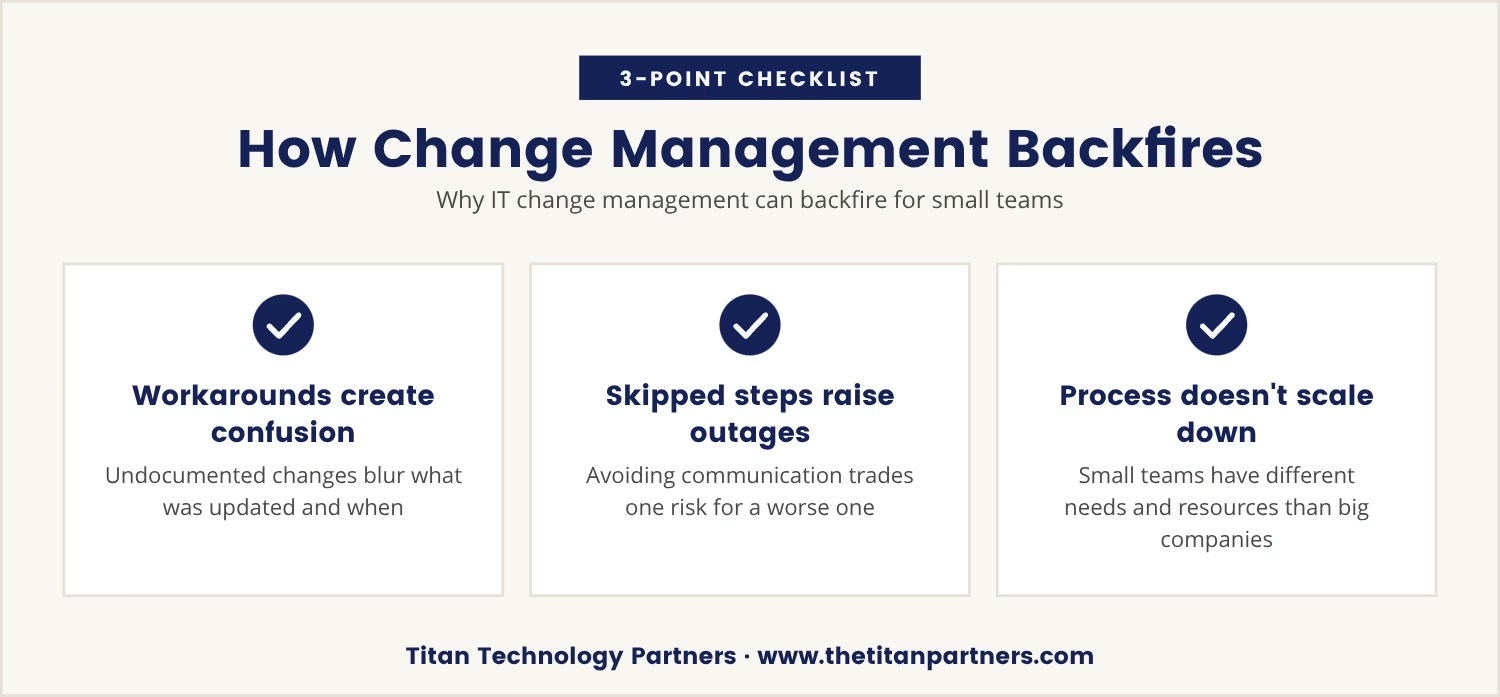
Why IT change management can backfire for small teams
Formal change management is supposed to cut downtime, and for a small business the reality often runs the other way.
A strict process introduces its own new risks: team members start working around it just to get things done at the speed the business actually needs. That workaround produces undocumented changes, and undocumented changes produce confusion about what was updated and when.
Push the complexity further, and people begin skipping steps or forgetting to communicate changes altogether, which trades one risk for a worse one — more outages, not fewer.
A process built for a large company doesn't scale down cleanly, because the needs, resources, and risks of a small team differ from the ones that process was designed to manage. Forced onto a team it wasn't built for, that same process makes things worse rather than better.
IT change management: What really happens after implementation
A formal IT change management process tends to deliver a predictable set of side effects once it's actually running, and few of them look like the improvement that was promised:
- Slower response times: Approvals and paperwork can delay urgent fixes.
- Process fatigue: Staff may feel overwhelmed by extra steps and lose motivation.
- Missed details: When the process is too rigid, important information can get lost in the shuffle.
- Shadow changes: People might bypass the process to save time, creating hidden risks.
- No real drop in outages: Despite all the effort, the number of disruptions may stay the same.
Each of these shows up for the same underlying reason: the process was copied directly from ITIL or another big-company framework without adjusting it to the team's actual size and needs.
The role of the change advisory board in small businesses
A change advisory board (CAB) is a group that reviews and approves changes before they happen, built on the idea that another set of eyes catches problems early.
That logic depends on available people, and a small team rarely has spare hands to pull into extra meetings away from their main work.
Even when the meeting happens, a CAB assembled from a small team may lack the right mix of technical and business knowledge, so the approvals it produces don't necessarily make anything safer or more reliable.
Rather than preventing issues, a CAB in this setting often just adds friction, slowing progress without the payoff it was meant to deliver.
When informal change management works better
Not every business needs a formal, documented process, and plenty run perfectly well without one.
A small team that already communicates well has often solved this problem informally, long before any framework entered the conversation; quick conversations and shared understanding do the job paperwork is meant to do.
That informal approach carries its own advantage: fixes happen the moment something goes wrong, with no approval queue or form standing between the problem and the solution.
None of this rules out structure entirely — some is still useful. The right amount depends on the team's size, its experience, and how complex its systems actually are.
How to find the right balance for your business
Getting the balance right means matching the process to the business rather than importing one wholesale. A few practical steps help make that judgment call.
Assess your real risks
Start by looking at the changes made most often, and whether they tend to go smoothly or cause trouble. That pattern shows exactly where structure earns its keep and where it's dead weight.
Identify bottlenecks
Where approvals are already slow, or meetings already pile up, more process only adds to the backlog. The priority is removing existing obstacles, not introducing new ones.
Involve the right people
Change reviews work best when the reviewers understand both the technical and business sides of what's changing. Without that mix, confusion and unnecessary delay tend to follow.
Keep documentation simple
A long report isn't necessary for every change. A quick note or checklist usually captures what happened just as well.
Adjust as you grow
A process is never finished, because the business behind it keeps changing. What fits a 15-user team won't necessarily fit one that's grown to 50, so the approach is worth revisiting on a regular basis.
The real risk of overengineering your change management
Lift a full ITIL change management process straight off the page without adjusting it, and the result is often more problems than the business started with. Time and money that could go toward real improvements get absorbed by process overhead instead.
For a small team, simplicity usually wins: clear communication, quick feedback, and just enough structure to stay safe. The goal was never to follow a process for its own sake — it was always to reduce risk.

Rethinking process for small IT teams
At Titan Technology Partners, we understand that businesses with 15 to 50 users often feel pressure to formalize IT processes, even when it doesn't fit their reality. Many teams like yours find themselves buried in process overhead, only to see the same old problems remain.
We invite you to see how we approach change management for small teams—balancing structure with flexibility, so you get the benefits without the burden. Let's talk about what works for your setup.
Ready to reduce process risk and secure your IT?
Get your IT environment secured and standardized in 90 days with Titan Technology Partners, or you pay no onboarding fee—available to qualifying businesses.
Frequently asked questions
What is the difference between a change request and an informal update?
A change request is a formal way to ask for approval before making an IT change, usually involving documentation and a review step. An informal update happens through direct communication, like a quick discussion or message, with no paperwork attached. Small teams often favor informal updates simply because they're faster and easier to manage.
How can I tell if my change management process is too complex?
A process has grown too complex when the team spends more time on approvals and paperwork than on actual IT work. Watch for frequent delays, staff frustration, and people quietly working around the steps that are supposed to be mandatory. A regular review of the workflow will show where it can be trimmed.
Do I need a change advisory board for effective change management?
A change advisory board suits large organizations with many stakeholders to coordinate. In a small business, a CAB tends to slow things down without adding much value, so the better move is making sure the right people are involved in decisions directly, without stacking on extra meetings or review layers.
What are the risks of automating every change in a small business?
Automation speeds things up, but it also introduces failure modes that are hard to catch when they're not set up carefully, since a mistake baked into an automated step can repeat before anyone notices. Small teams are usually better served automating only routine, low-risk changes while keeping closer, manual oversight on anything more complex.
How do I know when to add more structure to my change management activities?
Repeated mistakes, confusion about what changed, or frequent outages are the signals that more structure is overdue. Start small, with a simple checklist or shared notes, and add further steps only when they demonstrably help the team stay organized and reduce risk.